KARAMBIOSCIENCE
EST. 2026
EVIDENCE / 02
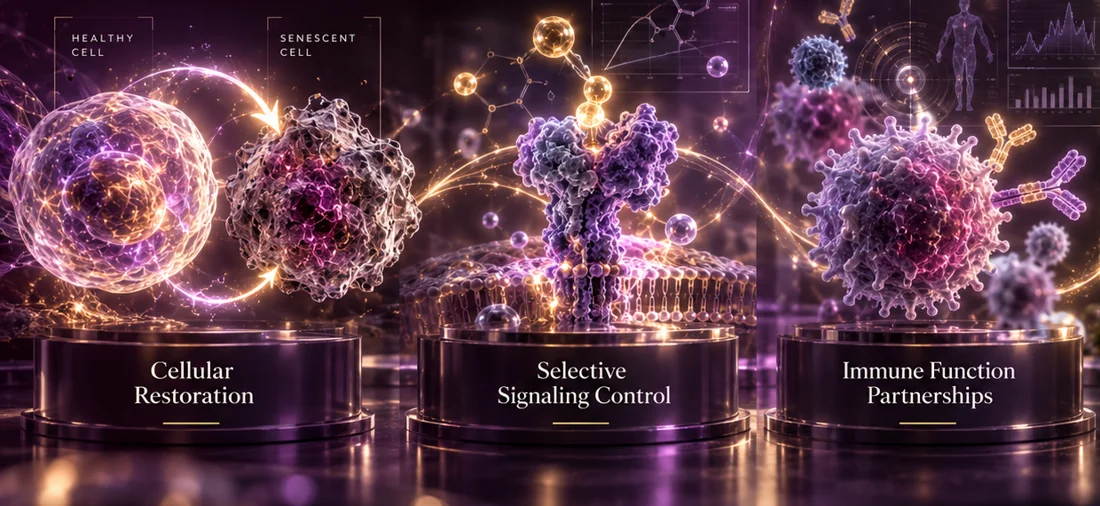
Four concept research directions: cellular restoration, selective signaling, immune function and climate biology.
CRISPR / Field guide
Research context · Assessment edition 15 October 2026

Can CRISPR reverse aging? What the research actually supports

Causal discovery, functional restoration, senescence removal and human rejuvenation are different claims.

Concept illustration / not experimental evidence

Use the strongest question, not the broadest promise

The supplied assessment recommends CRISPR as a research capability for testing causes of cellular dysfunction and possible restoration of useful function. Its reviewed studies do not establish safe reversal of normal aging throughout a human body.

A successful perturbation in a cell model is valuable because it can clarify mechanism. It remains a different kind of evidence from a patient outcome or a durable clinical benefit.

[C01] [C02] [C03] [C11] [C12] [C15] [C16] [C20]

Keep four outcomes separate

Senolysis removes senescent cells. A senomorphic intervention reduces damaging senescence-associated behavior. Functional restoration seeks to improve surviving cells. Escape from growth arrest may simply permit damaged cells to divide.

Those outcomes require different measurements. A fall in the average marker level could result from selective death; a proliferation signal could reflect expansion of a subset rather than repair of the original population.

[C01] [C02] [C03] [C11] [C12] [C15] [C16] [C20]

Read the recent target findings in context

GNPTAB–STING provides a selective-signaling lead in human-cell models. Aging T-cell screens provide context-specific immune-function findings, including mouse tumor evidence. Neither establishes whole-body rejuvenation.

The SRSF1 result is relevant but was not discovered in a CRISPR screen. Karam treats potential CRISPRa follow-up as a hypothesis and retains the small animal-cohort limitation of the underlying study.

[C01] [C02] [C03] [C11] [C12] [C15] [C16] [C20]

Human evidence does not remove the distinction

The assessment includes CTX310 as early, disease-related in vivo editing evidence and ER-100 as an early sponsor-reported reprogramming example. ER-100 is not CRISPR-Cas9 editing.

Biomarker changes and a few early observations should not be converted into claims of extended human lifespan. For Karam, the immediate objective is a reproducible target dossier, meaningful endpoints and qualified follow-up—not a consumer age-reversal treatment.

[C01] [C02] [C03] [C11] [C12] [C15] [C16] [C20]

Source trail

Scientific summaries are adapted from the supplied 15 October 2026 CRISPR Project Assessment. Source records show the original references and review access; this release is not a new systematic review.

C01 — Yin J, Gao Y, Jing Y, et al. CRISPR screening identifies GNPTAB as a noncanonical STING activator driving cellular senescence. Protein & Cell. 27 July 2026.C02 — Chen ACY, Ji KY, Yerinde C, et al. CRISPR screens identify targets to rescue age-related T cell dysfunction in cancer. Cell. 29 July 2026.C03 — Plesa AM, Jung S, Wang HH, et al. Transcriptomic reprogramming screen identifies SRSF1 as a regulator of aging. Nature Aging. 14 October 2026;6:2057–2073.C11 — Saroj N, Velangani HG, Kiran S, Dholaniya PS. Deletion of TOP2B promoter using CRISPR-Cas9 induces senescence in HEK 293T cells. Biochemistry and Biophysics Reports. 19 May 2026;46:102620.C12 — Lai C, Fu W, Liu J, et al. LMO7-mediated POLR2A degradation promotes cellular senescence through the MDM4/p53/p21 axis. Cell Death & Disease. 28 March 2026;17:421.C15 — Laffin LJ, Nicholls SJ, Scott RS. Durability of CRISPR-Cas9 Gene Editing Targeting ANGPTL3 with CTX310. New England Journal of Medicine. Online 28 August 2026;395:1343–1345.C16 — Life Biosciences. First-in-human data from the ongoing Phase 1 trial of ER-100 in optic neuropathies. Sponsor announcement. 8 October 2026.C20 — ClinicalTrials.gov; Life Biosciences sponsor record. Evaluating ER-100 for Safety in People With Glaucoma or Non-Arteritic Anterior Ischemic Optic Neuropathy. NCT07290244. Reviewed 15 October 2026.

Bring one question worth answering.

Tell us the decision, the evidence you have and the gap that blocks the next step. Start with nonconfidential context.