Disrupt a gene or create a sequence change through DNA repairCas9 nuclease
What follows when a defined gene function is disrupted?
- What changes
- DNA sequence; double-strand cutting and repair
Useful for causal loss-of-function research and selected disease models.
Boundary: The guide locates a target, but cellular repair helps determine the result. Intended and unintended outcomes require measurement.
[C06] [C09] [C10]
Lower gene activityCRISPRi
Does reducing expression improve the chosen function?
- What changes
- Gene regulation, generally without nuclease cutting
Lets a study ask about gene activity without equating repression with deletion.
Boundary: No DNA sequence change does not establish no risk or instant reversibility. Cell identity and persistence still matter.
[C01] [C22]
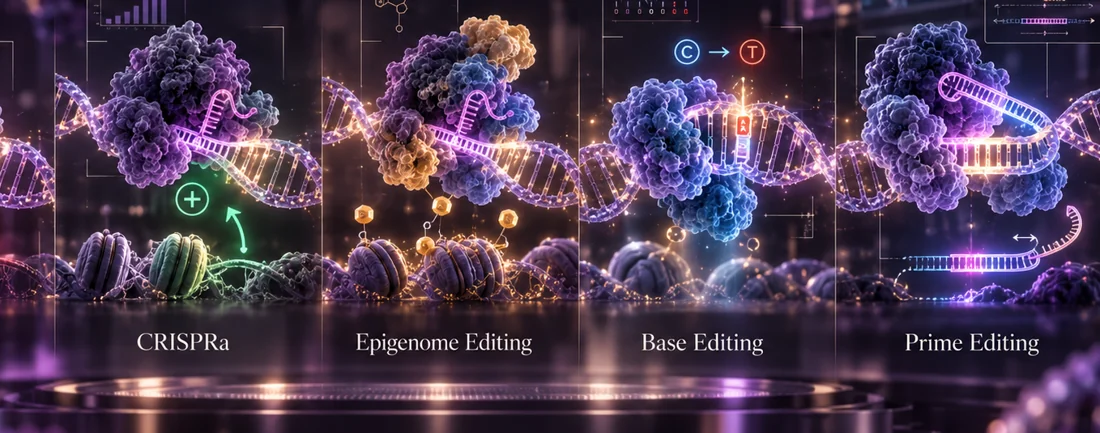
Raise gene activityCRISPRa
Could increasing a protective program improve function?
- What changes
- Endogenous gene activation
A route to testing activity restoration and context-dependent response.
Boundary: Increasing a gene can have broad effects. More proliferation or weaker growth checkpoints is not necessarily healthier biology.
[C03] [C12]
Change regulation of DNA or chromatinEpigenome editing
Could a regulatory change persist usefully without loss of identity?
- What changes
- Epigenetic regulation without rewriting base sequence
Useful for questions about durable gene control and compact regulatory systems.
Boundary: Persistence can be a liability as well as a benefit. Delivery and controllability must be established in the intended tissue.
[C04] [C06]
Make compatible DNA-letter conversionsBase editing
Is a defined causal sequence defect compatible with the editor?
- What changes
- Selected chemical base conversion
A candidate when the intended change fits the system.
Boundary: No deliberate double-strand break does not mean no unintended outcomes. Sequence and tissue constraints remain.
[C09] [C14]
Make defined substitutions, insertions or deletionsPrime editing
Can the required change and delivery context be supported?
- What changes
- Nickase plus reverse transcriptase and a specialized template-bearing guide
Supports a broader set of precise sequence questions; advanced systems explore larger changes.
Boundary: Prediction, efficiency, unintended outcomes, delivery and commercial software rights need separate assessment.
[C05] [C09] [C14]
Compare many perturbations as a discovery methodCRISPR screens
Which perturbations alter the measured phenotype in this model?
- What changes
- Depends on the editing or regulation modality used
Connects a target with an experimental effect rather than association alone.
Boundary: A hit ranking does not independently validate target biology. Model choice, confounders and orthogonal evidence determine interpretation.
[C01] [C02] [C08] [C22]