Evidence package
A target/context table with source dates, perturbation direction, contradictions and missing data.
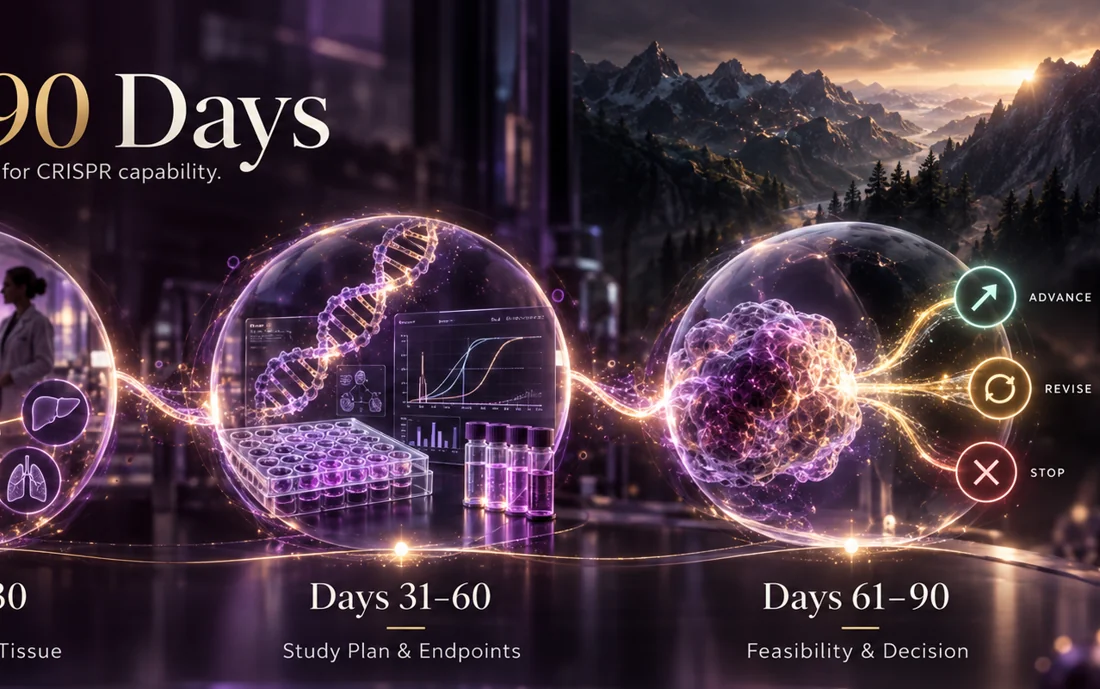
One cell context. One useful function. An explicit decision.
A focused comparison of regulated gene activity could identify a reproducible improvement in a relevant cellular function without loss of identity. This is a proposed hypothesis, not a Karam result.
A target/context table with source dates, perturbation direction, contradictions and missing data.
Specialist-approved cell model, functional and identity endpoints, independent units, data handover and safety questions.
If resources and approvals permit, a bounded partner study followed by a documented advance, revise or stop decision.
Aging-biology lead, functional-genomics partner, quantitative analyst and genome-safety expertise.
Do not classify increased proliferation, selective loss of damaged cells or escape from protective arrest as restoration. Revisit the hypothesis if specialized function or cell identity is not preserved.
An accountable scientific lead, authorized inputs, provider responsibilities, resources, relevant approvals, data handover, interpretation criteria and a written rights position. No named institution is presented as a contracted Karam partner.
A well-explained negative or inconclusive result can satisfy a properly scoped project. Acceptance should be based on the agreed work and evidence, not on a favorable claim.
Scientific summaries are adapted from the supplied 15 October 2026 CRISPR Project Assessment. Source records show the original references and review access; this release is not a new systematic review.
C01 — Yin J, Gao Y, Jing Y, et al. CRISPR screening identifies GNPTAB as a noncanonical STING activator driving cellular senescence. Protein & Cell. 27 July 2026.C03 — Plesa AM, Jung S, Wang HH, et al. Transcriptomic reprogramming screen identifies SRSF1 as a regulator of aging. Nature Aging. 14 October 2026;6:2057–2073.C11 — Saroj N, Velangani HG, Kiran S, Dholaniya PS. Deletion of TOP2B promoter using CRISPR-Cas9 induces senescence in HEK 293T cells. Biochemistry and Biophysics Reports. 19 May 2026;46:102620.C12 — Lai C, Fu W, Liu J, et al. LMO7-mediated POLR2A degradation promotes cellular senescence through the MDM4/p53/p21 axis. Cell Death & Disease. 28 March 2026;17:421.Scientific, analytical and laboratory partners can propose a specific contribution with evidence of their relevant work.